
Government schemes such as the PM E-Drive initiative, with allocations of around Rs 2,000 crore for charging points deployment, are helping accelerate rollout

The RBI panel has also recommended a government-sponsored 'fund of funds' of Rs 10,000 crore to support the venture capital and private equity firms investing in the MSME sector.

Banks given 180-day time for NPA resolution, matter to be referred to Insolvency Board within 15 days.

The Budget kept away from mood dampeners such as an increase in taxes (capital gain taxes) and even the much-feared introduction of Covid cess and wealth taxes, says Nimesh Kampani, chairman, JM Financial.
The new circular provides for a framework for early recognition, reporting and time-bound resolution of bad loans.

So far, among the IBC cases, SBI has been able to recover Rs 8,500 crore from Tata Steel's acquisition of Bhushan Steel. Another Rs 1,500 crore is in an escrow account on account of Electrosteel Steels.

Rather, the existing ones should be implemented speedily to clean up the mess.

Bankers said the SC verdict might prolong the resolution process and force lenders to bring back cases to the drawing board.
Banks to get more aggressive and act like PE investors

These together account for 40 per cent of bad loans of around Rs 4 trillion.

Under the watchful eyes of five wise men, who know the industry well, banks will not find it easy to hoodwink the system, says Tamal Bandyopadhyay.

New SDR norms allow promoters to manage debt-laden firms.
Central bank likely to keep tabs on large wilful defaulters; policy likely by month-end.
The gross bad debt of the Indian banking system as of March was at Rs 7.11 lakh crore

It is a national economic problem and one that requires a political solution hand in hand with a clear government commitment to stand behind core national assets, says Vinayak Chatterjee.

Bad loans continue to originate mainly from state-owned banks, where the top management's responsibility is not linked to career prospects nor has legal consequences, says Debashis Basu.

Finance Minister Nirmala Sitharaman on Monday presented the Budget for 2021-22 in the Lok Sabha that is expected to provide relief to the pandemic-hit common man as well as focus more on driving economic recovery through higher spending on healthcare, infrastructure and defence amid rising tensions with neighbours, As India emerges from the COVID-19 crisis, the ninth Budget under the Modi government, including an interim one, is widely expected to focus on boosting spending on job creation and rural development, generous allocations for development schemes, putting more money in the hands of the average taxpayer and easing rules to attract foreign investments.

This is the first time in the RBI's history that a governor is leaving without willing to renew his contract
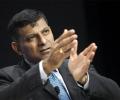
Rajan, as expected, furthered his predecessors' agenda and continued with the same resolution to make India's financial system safer, and direct the economy towards further liberalisation
For the past 10 years or more, the RBI has been turning down dozens of applications under the RTI Act that sought disclosing the list of wilful defaulters and the RBI's inspection reports. In fact, it is the only organisation that has a granular and complete view of the heist that has been going on for 25 years at least. But it has escaped any blame for the multiple rounds of bankruptcy and massive periodic recapitalisation of public sector banks caused by bad loans. In fact, they don't want anyone to know how incompetent and collusive they have been in handling bad loans, says Debashis Basu.

The market price action seems to point in this direction. Let's hope we finally break out. It is about time! asserts Akash Prakash.
Is the Budget sufficiently prudent? It probably is but at the cost of substantial under-provisioning for the many grand sounding schemes announced in it, says Nitin Desai.
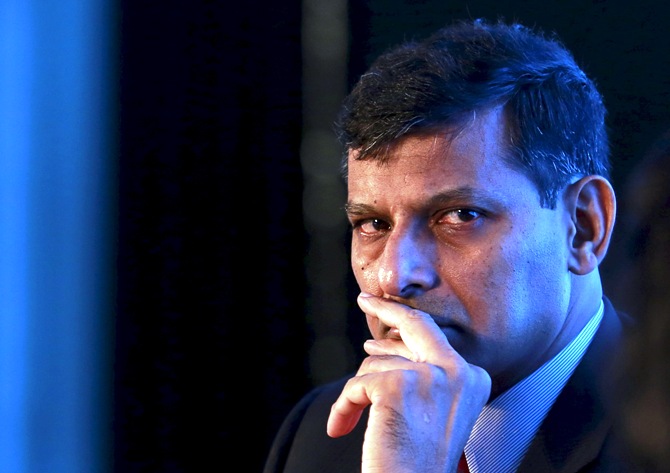
We need a change in mindset, says the RBI Governor.

Several factors seem to have corrected in India in the past six months, says the president of New Development Bank.
'We have promised to ensure reduced tax rates.'

Finance Minister Arun Jaitley presented the Union Budget.

'The finance minister and the government have met the immediate challenge. The wine this time is new and also in a new bottle, which, though not full, is less than half empty.'

NDA government has shunned populism.

Indian economy about to take-off

Cashi Crisis: Day 9: Aaj ki Taaza Khabar!

President Pranab Mukherjee on Monday addressed the first joint sitting of Parliament as mandatorily required under the Constitution after the general elections. The address is the political, economic and foreign policy road map of the Narendra Modi government and covers virtually all crucial areas.
 © 2026 Rediff.com - Advertise with us - Disclaimer - Privacy Policy - Sitemap - Feedback - About us - Terms of use - Grievances